
This Might Change Your Medicine Choice Forever
Which type of medicine is most effective for you: allopathic, natural, or functional? More and more people are opting for natural remedies, but it’s important to remember that not all natural treatments are suitable for every health condition. Let’s explore this further.
FUNCTIONAL MEDICINE
Sheryl Aguelo
12/8/20253 min read
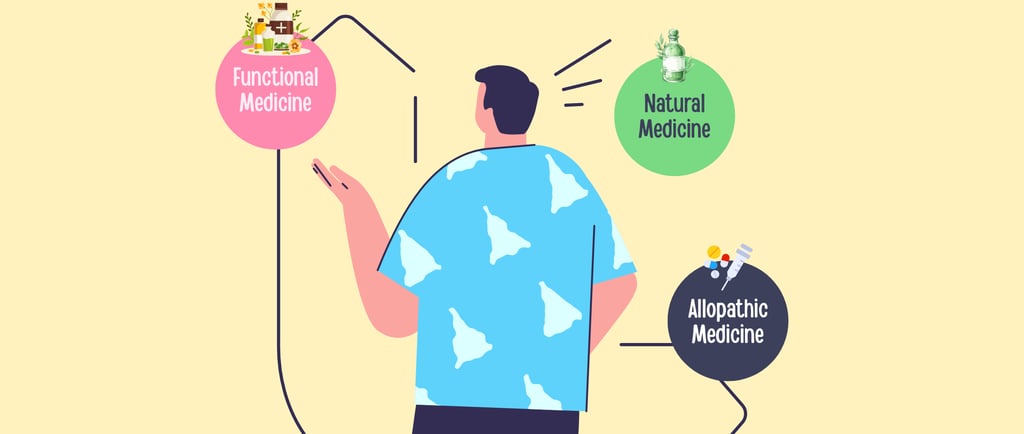

When I was a nursing student, I believed that allopathic medicine was superior to natural medicine. I thought natural remedies were quackery and unreliable. My college education had strongly influenced this view. At that time, natural medicine was not very popular, and even today, in some countries, allopathic medicine remains the standard form of treatment. Because of this, I accepted it as the truth.
Allopathic medicine typically treats only one organ or one specific symptom at a time. For example, if you are bloated, you may be given an antacid; if you have a fever, an antipyretic; if you have psoriasis, an NSAID. These treatments often suppress immune and nervous system activity, creating the impression that the disease is gone simply because the symptoms are no longer visible.
Natural medicine takes a different approach. It aims to address the root cause of a condition and treats the body as a whole rather than focusing only on symptoms. It considers how various body systems may be affected. It also follows the principle of a “health crisis,” meaning it does not suppress the nervous or immune systems. Instead, it supports their function so the body can release toxins and bacteria before true healing begins. This approach typically starts with the least invasive interventions: improving diet first, then using nutritional supplements, followed by botanicals, and turning to pharmaceutical drugs only when necessary.
When I started working as a nurse trainee in a hospital, I realized I couldn’t do much for patients, especially when I was assigned to a regular ward instead of the NICU or ICU. In the regular ward, my day-to-day tasks were mainly checking vital signs (blood pressure, temperature, pulse, and respiration) and monitoring intake and output for all the patients. Although some cases were more challenging, the routine felt very limited.
As nurses, we always follow the doctor’s orders to keep things going, because we don’t have much time in a day. I spent little time truly listening to patients, and doctors often only had about five minutes per patient because so many patients were waiting. That’s when I realized this wasn’t the type of work I wanted, even though I absolutely love medicine and have a deep curiosity about chronic diseases and natural treatments.
To make a long story short, I became a graphic designer and took various virtual assistant roles. During this time, I began watching documentaries, listening to lectures from natural medicine doctors, and reading books by Ellen G. White. I started searching for answers—particularly about why my aunt died of cancer and why their doctor friend advised us to avoid chemotherapy and instead try juicing and organic products.
Eventually, I decided to return to school. At first, I chose to study Natural Medicine, but because of my demanding work schedule, I realized I couldn’t keep up with both my job and my studies. I felt exhausted, and my brain didn’t function well after working all day and then trying to study at night. So I stopped pursuing Natural Medicine.
Two years later, that calling began tugging at me again. I re-enrolled at the Kingdom College of Natural Health and chose the Holistic Functional Medicine program. It’s a distance-learning course, and I genuinely enjoy all the subjects.
There are times when I’m tempted to go back to school to become a medical doctor and get licensed. But whenever I look at the subjects of allopathic medicine—anatomy and physiology, pharmacology, biochemistry—I feel no curiosity. Instead, I feel drained just thinking about them.
I am now pursuing Holistic Functional Medicine, which has concepts very similar to Natural Medicine. The difference is that it is more specific in addressing dysbiosis, infections, diet, toxins, and hormonal imbalances.
In Holistic Functional Medicine, we also learn how allopathic medicine views disease and compare it with the holistic functional medicine perspective—what the conventional approach is missing, what can be improved, and how these differences influence treatment. Holistic Functional Medicine is supported by extensive scientific evidence.
For emergency situations, allopathic medicine is excellent—such as in cases of stroke, heart attack, or severe allergies. For example, in a severe allergic reaction, epinephrine is essential. Holistic Functional Medicine, on the other hand, is especially suited for chronic conditions that allopathic medicine often considers difficult to treat because of the unknown cause, such as cancer and autoimmune diseases.
DaVeganry
Empowering your health through holistic functional medicine.
DaVeganry
Stay Updated
daveganry@gmail.com
© 2025. All rights reserved.